Living here
Damp, humidity, and the number IPMA stopped publishing
The short answer
IPMA's current climate normals for Madeira publish no relative humidity at all. The older 1971-2000 sheet for Funchal gives an annual mean just under three-quarters, measured once a day, and no equivalent exists for any north-coast or mountain station. Damp here tracks rainfall, altitude and aspect rather than one island figure.
Mean relative humidity, Funchal, 09h UTC
72%
Annual mean from the 1971-2000 normals, data 1971-1999, measured at a single daily observation. IPMA's current 1991-2020 normals sheet publishes no humidity at all.
IPMA / Instituto de Meteorologia, 1971-2000 normal period · check it · read August 26, 2026Lowest monthly mean relative humidity, Funchal (April)
69%
IPMA / Instituto de Meteorologia, 1971-2000 normal period · check it · read August 26, 2026Highest monthly mean relative humidity, Funchal
74%
Reached in January, February, July and December.
IPMA / Instituto de Meteorologia, 1971-2000 normal period · check it · read August 26, 2026Accumulated rainfall, Funchal, 1 Oct 2025 to 31 Jul 2026
599.0 mm
109% of the 1991-2020 normal for the period.
IPMA, hydrological year 2025/2026 to 31 July 2026 · check it · read August 26, 2026Accumulated rainfall, Santana (north coast), same period
1,125.5 mm
106% of normal. Published as 1125.5 mm.
IPMA, hydrological year 2025/2026 to 31 July 2026 · check it · read August 26, 20265 more sourced figures on this page
Accumulated rainfall, Chão do Areeiro (plateau), same period
2,562.4 mm
124% of normal. IPMA notes the Chão do Areeiro series uses WRF-modelled data for 1995-2002.
IPMA, hydrological year 2025/2026 to 31 July 2026 · check it · read August 26, 2026Accumulated rainfall, Porto Santo, same period
537.1 mm
149% of normal — the highest percentage of the four reference stations, and the lowest absolute total of the four, below Funchal’s.
IPMA, hydrological year 2025/2026 to 31 July 2026 · check it · read August 26, 2026Annual rainfall normal, Funchal
574.3 mm
The IPMA station normal for 1991–2020 at Funchal, Observatório (522). The regional hydrological study quotes a different long-run average for the same place over an unstated period; the two series are not interchangeable.
IPMA, 1991-2020 normal period · check it · read August 26, 2026Days a year with rainfall of 1 mm or more, Funchal
53.4 days
Of which 18.4 days reach 10 mm and 8.1 days reach 20 mm.
IPMA, 1991-2020 normal period · check it · read August 26, 2026Days a year with fog, Funchal observatory
0.3 days
Annual mean number of days with fog at station 522, near sea level, 1971-2000 series. No equivalent count is published for any mountain or north-coast Madeira station.
IPMA / Instituto de Meteorologia, 1971-2000 normal period · check it · read August 26, 2026Damp is the subject that decides whether a house on this island is a pleasure or a running repair, and the one a viewing has to answer for itself. It is also, awkwardly, the subject with the thinnest official data of anything on this site.
That is not a reason to write around it. It is the reason to be precise about what is measured, what is not, and what can be reasoned from the things that are. Everything below is either a published figure with a source or a mechanism described in words. Nothing in between.
What is actually measured, and what is not
IPMA's current climate normals sheet for Funchal, covering 1991 to 2020, publishes air temperature and precipitation. It publishes no humidity of any kind. That sheet was opened for this page and checked line by line; the variable is simply absent from the current series.
The previous series does carry it. The 1971 to 2000 normals sheet for Funchal/Madeira, station 522, at an altitude of 58 m, source: IPMA, read August 26, 2026, gives a mean relative humidity of 72%, source: IPMA / Instituto de Meteorologia, 1971-2000 normal period, read August 26, 2026, and the monthly values run from 69%, source: IPMA / Instituto de Meteorologia, 1971-2000 normal period, read August 26, 2026 in April to 74%, source: IPMA / Instituto de Meteorologia, 1971-2000 normal period, read August 26, 2026 in January, February, July and December.
Three caveats that matter more than the number
- It is measured at a single moment each day, 09h UTC, not averaged across twenty-four hours. Relative humidity swings enormously between dawn and mid-afternoon, so a single morning reading is not a description of a day.
- The underlying data runs from 1971 to 1999. It describes a period ending more than twenty-five years ago.
- It is Funchal. Station 522 sits on the sheltered south coast, near sea level, in the driest populated part of the island.
For the north coast and the mountains there is nothing. IPMA publishes standalone normals fact sheets for only two stations in the whole archipelago, Funchal and Porto Santo, and neither the current series nor the monthly Madeira climate bulletins report relative humidity for Santana, Chão do Areeiro, Ponta de São Jorge or anywhere else. A relative-humidity figure for the north coast of Madeira does not exist in the official record. Any page that quotes one has taken it from a model, from a weather app, or from nowhere.
The measurement that does exist, and what it shows
What IPMA does publish for the north and the high ground is rainfall, and it publishes it in a form that settles the argument. Its Madeira climate bulletin reports accumulated precipitation for the hydrological year across four reference stations at once, so the comparison is like for like.
From 1 October 2025 to 31 July 2026, the same ten months at each station:
- Funchal/Observatório, on the south coast: 599.0 mm, source: IPMA, hydrological year 2025/2026 to 31 July 2026, read August 26, 2026
- Santana, on the north coast: 1,125.5 mm, source: IPMA, hydrological year 2025/2026 to 31 July 2026, read August 26, 2026
- Chão do Areeiro, on the central plateau: 2,562.4 mm, source: IPMA, hydrological year 2025/2026 to 31 July 2026, read August 26, 2026
- Porto Santo: 537.1 mm, source: IPMA, hydrological year 2025/2026 to 31 July 2026, read August 26, 2026
The plateau took more than four times Funchal's rainfall over the identical period. The north coast took close to twice it. These are not modelled estimates or averages of averages; they are one instrument's accumulated total against another's, printed side by side in the same document.
The wind explains why
IPMA's wind roses for the same month show the mean wind arriving predominantly from the northern quadrant, with a sharply defined north-easterly component at Chão do Areeiro. Moist Atlantic air arrives on the north side, is forced up over the ridge, cools, and drops its water on the way. What reaches the south coast has already been wrung out. That is the entire mechanism, and it is why the north looks the way it does in the photographs.
For context on the south side, the long-run Funchal normal is 574.3 mm, source: IPMA, 1991-2020 normal period, read August 26, 2026 a year, falling on 53.4 days, source: IPMA, 1991-2020 normal period, read August 26, 2026. Funchal is a dry place by any European standard. It is also, on the same instrument, a place with a mean morning humidity just under three-quarters. Both things are true, and the tension between them is the whole subject.
Why aspect and altitude decide it, not the island
Condensation forms where air meets a surface colder than its dew point. That is a statement about surfaces, not about a climate, and it is the reason two houses on the same street behave differently.
Three variables drive it: how cold the wall gets, how much water is in the air touching it, and how much of that air is exchanged for drier air. Madeira loads the dice on all three in particular places.
Aspect
A north-facing wall on this island receives no direct winter sun. Its outer face stays cold, its inner face stays cold, and every warm humid airmass that touches it gives up water. The same wall facing south gets heated for hours a day and dries between events. This is ordinary building physics rather than anything Madeiran, but the island's relief makes aspect unusually decisive: a valley wall can put a house in shadow for most of a winter day even on the south coast.
Altitude
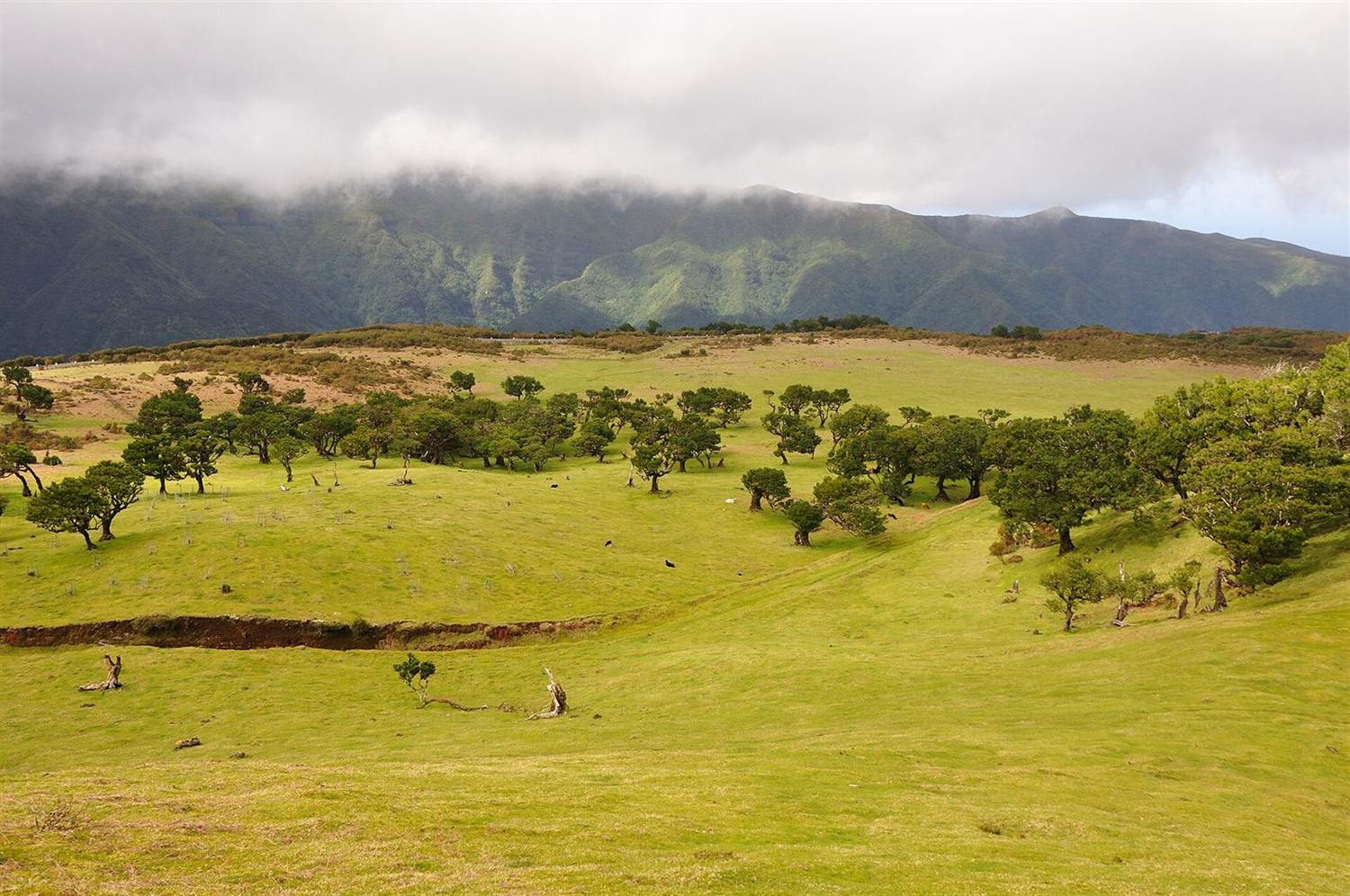
Height does two things at once. It lowers the temperature, and on this island it also raises the rainfall — the plateau figure above is the measurement of that. A house above the usual cloud base spends part of the year inside cloud rather than under it, which is a different exposure from rain. IPMA's own bulletins name fog on the plateau; the regional tourism service states plainly that fog and cooler temperatures are common in the mountains while it is sunny and warm at the sea.
How different those two places are
Funchal's observatory recorded a mean of 0.3 days, source: IPMA / Instituto de Meteorologia, 1971-2000 normal period, read August 26, 2026 across the 1971 to 2000 series, roughly one foggy day every three years at that station. The same island's plateau is known for cloud that sits on the ground. The distance between those two facts is about twenty minutes by road, and it is the single most important thing to understand before choosing between the coasts and the altitudes on offer.
What shows up in a viewing
This is where the subject stops being climate and becomes a property matter, which is why it belongs alongside how a purchase here actually runs rather than in a weather page.
The signals are the ordinary ones and none of them needs equipment: staining low down on a wall and at the junction of wall and ceiling; marks behind furniture standing against an external wall; blistered or lifting paint; salt deposits on plaster; a bloom in the corners of a cool room; and the smell that returns when a closed-up room is opened.
The smell is the most reliable of them, for an unglamorous reason: it is the hardest thing to remove for the length of a viewing. Staining can be painted, furniture can be moved, and a house can be aired for a morning. A room that has been shut for a fortnight tells the truth in about four seconds.
The question that separates a defect from a climate
Damp on a north-facing wall in a high village is not necessarily a fault in the building. It may be the building performing normally in a place where the air is wetter and the wall is colder. The distinction that matters is whether water is arriving from outside through a failure, a roof, a gutter, a crack, ground water rising into a wall without a barrier, or condensing on the inside out of the air in the room. Those have different causes, different costs and different consequences for a price.
No Madeira-specific published figures were found for the cost of remedying either, for the prevalence of either in the housing stock, or for any regional building requirement addressing them. Those numbers are not given here because they were not found, and inventing them would be worse than leaving the gap visible.
What can honestly be said about mitigation
The physics allows only three levers, and every product sold on this island is one of them wearing a different name: warm the surface, remove water from the air, or exchange the air.
Heating raises wall temperature above the dew point. Dehumidification removes water directly. Ventilation replaces humid indoor air with drier outdoor air, which works when the outdoor air is drier, and which is precisely the assumption that fails on a wet north-coast morning in February. That last point is the one most general advice written for northern Europe gets wrong when it is applied here.
What none of these do is fix water arriving through a fabric failure. A dehumidifier running against a leaking gutter is an electricity bill, and electricity here is not cheap — the published rates are set out in what living on the island actually costs.
The seasonal pattern is worth reading alongside what each month actually looks like: the rain concentrates from October through March, and those are the same months in which a wall gets least sun. The two effects arrive together rather than taking turns.
Questions people actually ask
How humid is Madeira?
The only published answer covers Funchal, from a superseded series: a mean relative humidity of 72%, source: IPMA / Instituto de Meteorologia, 1971-2000 normal period, read August 26, 2026 measured at 09h UTC across 1971 to 2000, ranging from 69%, source: IPMA / Instituto de Meteorologia, 1971-2000 normal period, read August 26, 2026 to 74%, source: IPMA / Instituto de Meteorologia, 1971-2000 normal period, read August 26, 2026 by month. IPMA's current normals publish no humidity at all, and there is no published figure for the north coast or the mountains.
Is damp a real problem in Madeira houses?
The conditions that cause it are measurably concentrated in particular places. Over the same ten months of 2025 and 2026 the central plateau recorded 2,562.4 mm, source: IPMA, hydrological year 2025/2026 to 31 July 2026, read August 26, 2026 of rain against 599.0 mm, source: IPMA, hydrological year 2025/2026 to 31 July 2026, read August 26, 2026 in Funchal. Whether a specific house has a problem depends on aspect, altitude, construction and ventilation, and no official prevalence data for Madeira housing was found.
Is the north coast of Madeira damper than the south?
Wetter, certainly — Santana recorded 1,125.5 mm, source: IPMA, hydrological year 2025/2026 to 31 July 2026, read August 26, 2026 against Funchal's 599.0 mm, source: IPMA, hydrological year 2025/2026 to 31 July 2026, read August 26, 2026 over the identical period, on IPMA's own accumulated totals. Damper indoors is a related but different question, and it cannot be answered from the official record because no north-coast relative-humidity series is published.
Which houses in Madeira suffer most from damp?
The physics points at north-facing walls, which get no direct winter sun and stay cold, and at houses at altitude, where it is colder and it rains far more. A house above the usual cloud base can sit inside cloud rather than under it. Funchal's own station records only 0.3 days, source: IPMA / Instituto de Meteorologia, 1971-2000 normal period, read August 26, 2026 of fog a year at sea level; the plateau is a different place entirely.
Does a dehumidifier solve damp in Madeira?
It addresses condensation, which is water coming out of the air inside a room. It does nothing about water entering through a roof, a gutter, a crack or the ground. Ventilation also assumes the outside air is drier than the inside air, which is not reliable on a wet north-coast morning. No Madeira-specific remediation cost data was found.
Where this came from
- IPMA: Normal Climatológica 1991-2020 — Funchal (station 522). ipma.pt/bin/file.data/climate-normal/cn_91-20_FUN Read August 26, 2026.
- IPMA / Instituto de Meteorologia: Normais Climatológicas 1971-2000 — Funchal/Madeira (522). ipma.pt/bin/file.data/climate-normal/cn_71-00_FUN Read August 26, 2026.
- IPMA: Boletim Climatológico Região Autónoma da Madeira, Julho 2026. ipma.pt/resources.www/docs/im.publicacoes/edicoes Read August 26, 2026.
- IPMA: Normal Climatológica 1991-2020 — Porto Santo (station 524). ipma.pt/bin/file.data/climate-normal/cn_91-20_POR Read August 26, 2026.
- Visit Madeira (Direção Regional do Turismo): Frequently asked questions — microclimates and mountain conditions. visitmadeira.com/en/travel-info/faq/ Read August 26, 2026.