Visiting
What to eat and drink on Madeira
The short answer
Madeira's own dishes are espetada, beef grilled on a bay-laurel skewer; bolo do caco, a sweet-potato flatbread; grilled limpets; black scabbardfish served with fried banana; picado; and poncha, made from sugarcane spirit. Poncha da Madeira and Rum da Madeira are protected European names. The couvert charge is governed by national law, not regional rules.
Espetada, beef cubes on a bay-laurel skewer
€18.90 per skewer
As Vides, Estreito de Câmara de Lobos, published menu. The menu also states the equivalent kilo price, €47.25/kg.
As Vides, 2026 · check it · read August 26, 2026Espetada, beef cubes on a plain skewer
€17.90 per skewer
Same restaurant, same menu, same beef. The only stated difference is the skewer.
As Vides, 2026 · check it · read August 26, 2026What the bay-laurel skewer costs
€1.00
Derived. It is the difference between two lines on the same published As Vides menu — €18.90 with the laurel skewer, €17.90 without. Both inputs are published by the restaurant; the subtraction is ours.
As Vides, 2026 · check it · read August 26, 2026Espetada, pork cubes over embers
€9.90 per skewer
As Vides published menu. The cheap alternative to beef.
As Vides, 2026 · check it · read August 26, 2026Bolo do caco with garlic butter, as a starter
€3.80
As Vides published menu, listed under ENTRADAS as homemade bread with garlic butter.
As Vides, 2026 · check it · read August 26, 2026Milho frito as a side dish
€5.20 or €6.20
Two portion sizes on the As Vides menu, priced the same as rice, chips or salad.
As Vides, 2026 · check it · read August 26, 202613 more sourced figures on this page
Bread course at a contemporary Funchal restaurant
€5.90
Kampo, Funchal — artisan bread, olive and white butter, priced as a dish on the published menu rather than presented as couvert.
Kampo, 2026 · check it · read August 26, 2026Corkage (taxa de rolha), Kampo, Funchal
€20.00
Published on the restaurant's own menu.
Kampo, 2026 · check it · read August 26, 2026Banana da Madeira, supermarket price
€2.99 per kg
Pingo Doce online store, sold in a 1.2 kg pack. A live retail price read on the day, not an index.
Pingo Doce, 2026 · check it · read August 26, 2026Black scabbardfish fishing depth
800 to 1,200 m
Fished with a horizontal drifting deep-water longline, known locally as the espinhel or aparelho de espada.
Direção Regional do Mar (Região Autónoma da Madeira), the fishery · check it · read August 26, 2026Black scabbardfish landings, Madeira
2,136 tonnes worth €6.39 million
Second only to tuna among Madeira fisheries in that year.
Direção Regional do Mar (Região Autónoma da Madeira), 2020 · check it · read August 26, 2026MICHELIN Guide entries on Madeira
12
One Two-Star (temporarily closed for refurbishment), two One-Star, one Bib Gourmand and eight selected without a distinction. Read from the Portugal-locale listing; the global-locale path returns a false negative.
MICHELIN Guide, MICHELIN Guide Portugal 2026 · check it · read August 26, 2026Mercado dos Lavradores opening hours
Monday to Friday 07:00–19:00, Saturday 07:00–14:00
Closed Sundays and public holidays.
Câmara Municipal do Funchal, 2026 · check it · read August 26, 2026Mercado dos Lavradores covered area
9,600 m²
Inaugurated 24 November 1940 to a design by the architect Edmundo Tavares.
Mercados do Funchal (Câmara Municipal do Funchal), the building · check it · read August 26, 2026Restaurante Santo António opening hours
every day, 12:00–23:00
Closed 25 December; no dinner service on 24 and 31 December. The restaurant states on the same site that it takes no reservations.
Restaurante Santo António, 2026 · check it · read August 26, 2026Pingo Doce stores on Madeira and Porto Santo
14 stores
Counted from the chain's own Lojas Madeira store-locator filter.
Pingo Doce, 2026 · check it · read August 26, 2026Continente stores on Madeira
17 locations
Counted from the chain's own Madeira store page, including Continente Modelo and Continente Bom Dia formats.
Continente (Sonae MC), 2026 · check it · read August 26, 2026Charged for a small bag of fruit, documented incident
€85.71
A single documented incident reported by Público in July 2021, not a market rate. Público blocks direct retrieval; read through the Internet Archive.
Público (via Internet Archive), One documented incident, Funchal, July 2021 · check it · read August 29, 2026Two full bags of similar fruit, traditional greengrocer across the street
no more than €10
Público: "do outro lado da rua, numa frutaria tradicional, o mesmo jornalista sai com dois sacos cheios de fruta semelhante e não paga mais de 10 euros." Two bags of SIMILAR fruit, not one bag of the same fruit — so this is not a like-for-like price, and the real per-item gap is wider than the two figures suggest.
Público (via Internet Archive), One documented incident, Funchal, July 2021 · check it · read August 29, 2026This page starts with the food and reaches the restaurants late, for a reason that has nothing to do with cooking. A dish cannot close down. Every named business below has either its own live website or a listing on an official body, opened and read on 26 August 2026, and twenty candidates that could not clear that bar were left out rather than filled in from memory.
Where a published source carries a price, it is here with the menu it came from. Where none does, a coffee, a glass of poncha, a whole espetada plate, this page says so instead of inventing a figure.
Espetada, and the euro that buys the tradition
Espetada is chunks of beef roasted on a bay-laurel stick over charcoal. The Madeira tourism board describes it in exactly those terms: beef, garlic, bay leaf, charcoal grill. The parish council of Estreito de Câmara de Lobos gives the fuller version — beef cubes on a laurel skewer, seasoned with coarse salt, garlic and bay leaves, then grilled slowly over embers.
It was festival food first. The same parish council records that espetada was eaten at arraiais, romarias and popular festivals, served on large skewers and often accompanied by nothing but bread and wine, and that it moved indoors in the 1950s when Francisco da Silva Freitas began serving it at a small bar that became the restaurant As Vides. As Vides tells the same story on its own site.
The laurel skewer is not decoration and it is not free. As Vides publishes both versions on one menu: €18.90 per skewer, source: As Vides, 2026, read August 26, 2026 for beef cubes on a bay-laurel skewer, €17.90 per skewer, source: As Vides, 2026, read August 26, 2026 for the same beef on a plain one. The gap is €1.00, source: As Vides, 2026, read August 26, 2026. That is the entire measurable cost of the tradition, and it is the most informative line on any Madeira menu.
Pork is the cheap skewer at €9.90 per skewer, source: As Vides, 2026, read August 26, 2026. Sides are ordered separately, and milho frito, the standard one, runs €5.20 or €6.20, source: As Vides, 2026, read August 26, 2026 depending on portion. Milho frito is cornmeal cooked to a cream, set, cut into cubes and deep-fried. It is not sweetcorn.
Bolo do caco is a sweet-potato bread
Bolo do caco is a round flat bread, served warm, split, and spread with garlic and parsley butter. The distinguishing ingredient is sweet potato, and that is not a matter of opinion: the tourism board states it outright and says the sweet potato is what gives the bread its texture.
The name comes from the caco, the very hot basalt stone the dough was baked on, not from the shape of the loaf. As a starter with garlic butter it is €3.80, source: As Vides, 2026, read August 26, 2026 at As Vides. As lunch it becomes the prego no bolo do caco, a steak in the bread, which is the cheap, unglamorous, non-touristy thing to order and bears no relation to the mainland prego no pão.
The sweet potato itself now carries a European protected name of its own. Batata-Doce da Madeira was registered as a PDO in 2024, one of the eight Madeira names on the EU register.
The fish comes from a long way down
Peixe-espada preto, black scabbardfish, Aphanopus carbo, is a deep-water fish taken on a horizontal drifting longline known locally as the espinhel or the aparelho de espada. The Madeira regional marine directorate puts the fishing depth at 800 to 1,200 m, source: Direção Regional do Mar (Região Autónoma da Madeira), the fishery, read August 26, 2026, calls the fishery centennial, and describes it as one of the regional fishing resources with the greatest tradition and impact on regional cooking. It also notes that the fleet lands two species that cannot be told apart at market.
The scale is not small. The directorate recorded 2,136 tonnes worth €6.39 million, source: Direção Regional do Mar (Região Autónoma da Madeira), 2020, read August 26, 2026 in 2020, second only to tuna among Madeira fisheries. The tradition sits in Câmara de Lobos, because that is where the boats are.
On a menu it is filete de espada, breaded and fried, served with fried banana. The pairing looks like something invented for visitors and is not — the tourism board names both banana and passion fruit as the traditional accompaniments to it.
Lapas are limpets, prised off the coastal rocks, grilled with garlic, butter, parsley and lemon, and brought to the table still in the pan they were cooked in. They are priced by the dose rather than by the piece, which makes ordering them harder to judge than it looks. Tuna arrives as bife de atum: marinated, fried hot so the marinade becomes the sauce, and served with milho frito. Picado is the shared plate — small pieces of beef in sauce with chips, eaten communally with forks straight from the dish.
Poncha, and the detail no official source confirms
Poncha is aguardente de cana, sugarcane spirit, with honey and lemon, stirred hard with a wooden tool called the mexelhote. The tourism board names the spirit and the stick as the two things that can never be left out of it. Funchal's municipality gives the base as aguardente, sugar and lemon peel.
Poncha a pescador is described by the tourism board as the original, and it came out of Câmara de Lobos, made to warm fishermen through long cold nights at sea. A further distinction is then drawn between poncha a pescador and poncha regional, usually that the regional version adds orange juice. No official source publishes that split. It appears in blogs and recipe sites and nowhere the tourism board or the municipality controls, so it is not stated here.
The flavoured versions are official. Passion fruit is named as one of the most popular, with tangerine, mint and tomate inglês alongside it. Tomate inglês is worth a caution of its own: the name is used locally for two different plants, the tamarillo and the cape gooseberry. The regional agriculture service identifies tomate inglês as the tree tomato or tamarillo — Solanum betaceum, published there under the older synonym Cyphomandra betacea — a Solanaceae native to the Andes. It does not settle the local ambiguity: its own pages on the cape gooseberry call that fruit tomate de capucho and never use tomate inglês at all, which is silence rather than a ruling. Its host is now offline and the page is read through the Internet Archive.
Poncha da Madeira is itself a protected European geographical indication for a spirit drink, and so is Rum da Madeira, the base spirit. Both are on the register, which is more than can be said for most of the dishes on this page.
Nikita, pé de cabra, and the brewery
Nikita is the other island drink, and the two official sources disagree about what is in it. The tourism board says ice cream, pineapple, pineapple juice and pale beer. Funchal municipality says pineapple ice cream, sugar, pineapple slices, and white wine and/or beer, and adds that it may contain no alcohol at all. The origin story repeated everywhere, invented in Câmara de Lobos, named after the Elton John song, has no official source and is not repeated here.
Pé de cabra is rarer and stranger: dry wine, dark beer, sugar, powdered chocolate and lemon peel, per the municipality. It also turns up as a dessert flavour on a one-star tasting menu, which says something about how seriously the island takes it.
Coral beer, the Brisa range and Laranjada all come from one company, Empresa de Cervejas da Madeira, whose plant is in Câmara de Lobos rather than Funchal. Laranjada is commonly mixed with wine or with Coral. An 1872 founding date circulates for the company. It does not appear on the company's own site, so this page does not use it.
Sweet things, and the fruit
Bolo de mel is the Christmas cake that is eaten all year. The mel is sugarcane molasses, not bee honey — one Portuguese word covers both, which is where the mistranslation comes from. The tourism board dates it to the fifteenth century, when Madeira was one of the world's largest sugarcane producers, and lists the build: leavened dough rich in butter and lard, walnuts, sugarcane honey, spices, Madeira wine and candied citrus peel. The custom of breaking it by hand rather than cutting it with a knife is not on the official page, so it is not asserted here either.
Broas de mel are the biscuit version, made with the same sugarcane honey plus cinnamon and lemon zest. Queijada da Madeira is curd cheese, eggs and sugar, flat and soft, and the curd cheese is requeijão, which now holds a European protected name while the queijada made from it does not. Pudim de maracujá, passion-fruit pudding, is the standard dessert at an espetada house. Malassadas belong to Carnival.
The fruit is where the island stops resembling the rest of Portugal. Anona da Madeira, the custard apple, is the only Madeiran fruit holding an EU Protected Designation of Origin, registered in 2000. Fruto delicioso is the fruit of the Monstera deliciosa vine and tastes, per the tourism board, of banana, pineapple and cherimoya at once. Chestnuts get their own festival at Curral das Freiras in October and November.
Banana da Madeira: two sources that do not agree
Banana da Madeira is a small, sweet, creamy dessert banana grown mainly on the south coast. Its protected status is contested by the two sources that ought to agree with each other.
visitmadeira.com, the Madeira Islands Tourism Board, states that Banana da Madeira holds Protected Geographical Indication status. A direct query of the European Commission's own eAmbrosia register on 26 August 2026 returned no record for Banana da Madeira at any status, while returning Banana dos Açores as an applied-for PGI, and eight other registered names carrying the word Madeira. The Portuguese national traditional-products register lists it without any DOP or IGP suffix, unlike Anona da Madeira DOP.
Those two sources conflict. This page does not pick a side, and nothing quoting this page should either. What is not in dispute: it is a distinct local variety, and in a supermarket it is €2.99 per kg, source: Pingo Doce, 2026, read August 26, 2026.
The restaurants, and the bar they had to clear
A named restaurant here has either its own live website or a listing on an official body, the tourism board, a municipality, a parish council or the MICHELIN Guide, that was opened and read on 26 August 2026. Twenty candidates failed that test and were left out. Most of them exist. Several are famous. What they do not have is a source that survives being checked, and a restaurant that shut two years ago is the fastest way for a page like this to become worthless.
The MICHELIN Guide selection
The MICHELIN Guide Portugal 2026 selection was unveiled on 10 March 2026 at the Savoy Palace in Funchal. It gives Madeira 12, source: MICHELIN Guide, MICHELIN Guide Portugal 2026, read August 26, 2026 entries: one Two-Star, two One-Star, one Bib Gourmand, and eight further restaurants selected without a distinction. Eleven are in Funchal. One, Vila do Peixe, is in Câmara de Lobos, and no MICHELIN Guide restaurant on the island sits outside those two municipalities. None holds a Green Star.
The Two-Star is Il Gallo d'Oro, and as at 26 August 2026 the MICHELIN Guide's own entry for it carries the note Temporarily closed for refurbishment. It is not a bookable restaurant at the time of writing, and anyone planning a trip around it needs to re-check the listing first.
The One-Stars are William, at Reid's Palace, named after the hotel's Scottish founder; and Desarma, on a hotel terrace in Funchal, whose cellar MICHELIN describes as holding one of the world's best selections of Madeira wines. The Bib Gourmand, MICHELIN's mark for good cooking at a fair price, and the only one on the island, is Casal da Penha, a family-run restaurant in central Funchal with a roof terrace.
One warning for anyone checking this at source: the global-locale MICHELIN URL for Madeira returns Unfortunately there are no selected restaurants in the area you've searched for. That is a false negative produced by the locale, not a fact about the island. The Portugal-locale listing is the one that answers.
Espetada, where it started
As Vides, in Estreito de Câmara de Lobos, has been grilling espetada over acacia embers since 1950 and publishes a full menu with prices, which is rarer than it ought to be. It takes bookings by telephone only and has no online form.
Restaurante Santo António, in the same parish, was founded in 1966 and is still run by two of the founder's sons. Its menu is deliberately short: espetada in pau de louro, spit chicken, beef cutlet. It serves every day, 12:00–23:00, source: Restaurante Santo António, 2026, read August 26, 2026 and states on its own site that it takes no reservations at all, first come, first served. That single fact changes how an evening there has to be planned, and it is the sort of thing a booking site will never tell anyone.
Elsewhere on the island
Kampo, in Funchal, publishes its prices and carries a serious Madeira wine list by the glass. Casa das Espetadas, on the Estrada Monumental, is listed by the tourism board for traditional cooking in a wood oven.
Past those, the honest unit is the place rather than the restaurant. Porto Moniz and Seixal have a dense cluster of fish restaurants beside the volcanic pools, and the Porto Moniz municipality lists nineteen of them across the municipality with names and telephone numbers but no hours or prices. Calheta's municipality does the same for the seafront restaurants of Paúl do Mar and Jardim do Mar, two former fishing villages reached by tunnel where the tables sit directly on the water. Getting to either is a drive rather than a stroll, the practicalities are in the guide to getting around Madeira.
The poncha bars of Câmara de Lobos are deliberately left unnamed. The well-known ones have no website and appear on no official listing, and naming them would mean sourcing a recommendation to TripAdvisor. The bars around the harbour and the Largo do Poço make poncha to order with the mexelhote, and a glass of it is among the cheapest drinks on the island.
The market, and the stalls to be careful with
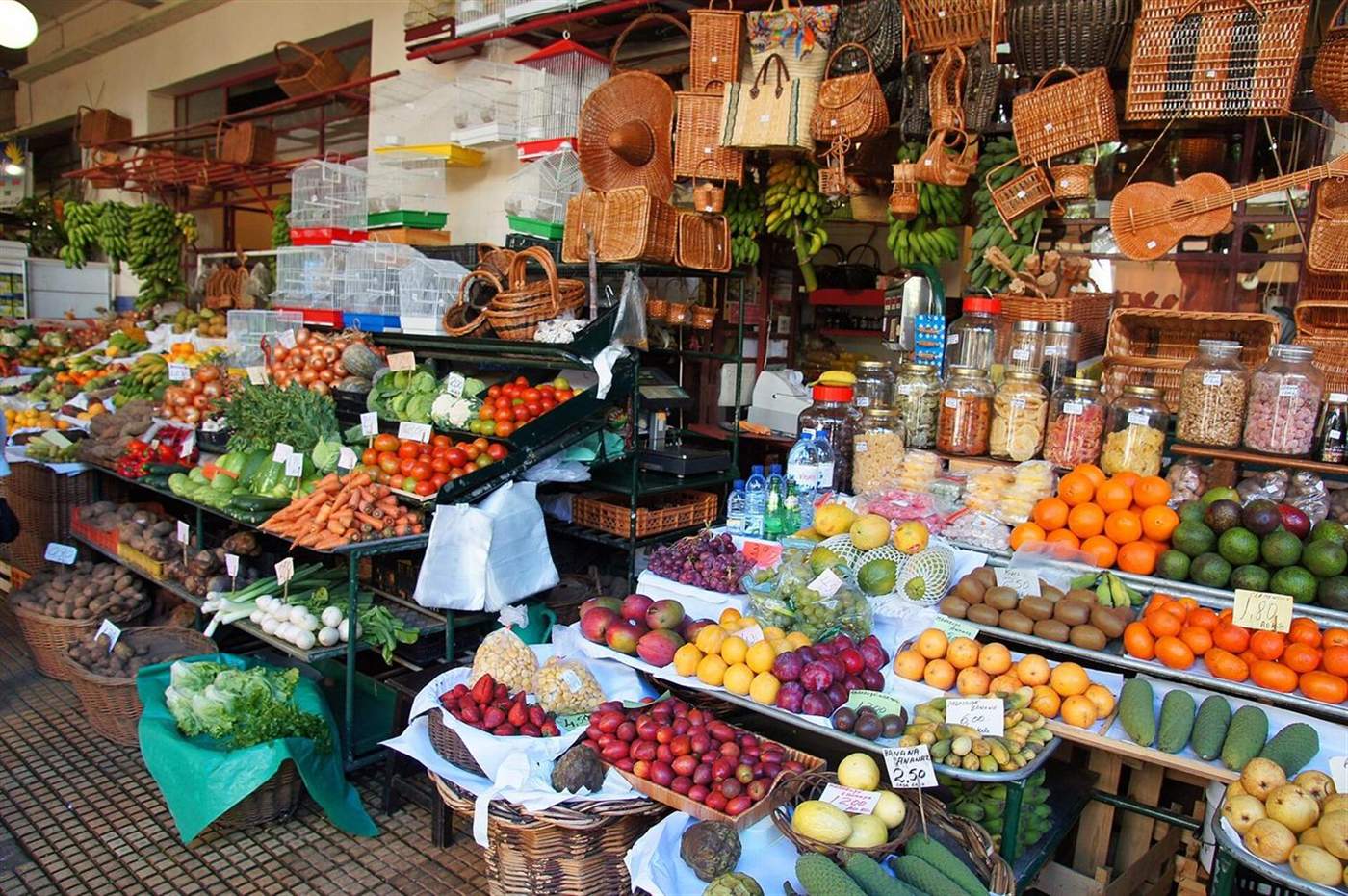
Mercado dos Lavradores opened on 24 November 1940 to a design by the architect Edmundo Tavares: a modernist Estado Novo building with 9,600 m², source: Mercados do Funchal (Câmara Municipal do Funchal), the building, read August 26, 2026 of covered floor, tile panels on regional themes, a worked-stone pergola and marble drinking fountains. Funchal's markets authority calls it the only significant supply hub for the city, mainly in fish. It trades Monday to Friday 07:00–19:00, Saturday 07:00–14:00, source: Câmara Municipal do Funchal, 2026, read August 26, 2026 and closes on Sundays and public holidays, which ruins the lazy Sunday morning most itineraries plan around it.
The fish hall is the reason to go. Black scabbardfish and tuna are sold whole, and it is the clearest look anyone gets at what the island actually lands.
The fruit stalls at the tourist end are a different matter, and this is the part a brochure leaves out. In July 2021 a German television programme filmed the practice, and Portuguese national and regional press, Público and the Madeira daily DNotícias, reported that exotic fruit was being sweetened with added sugar before being handed over as free samples, then sold at grossly inflated prices. Funchal's câmara municipal opened investigations into three fruit-selling spaces. Enforcement of pricing and adulteration rules sits with the regional economic activities authority, ARAE.
The figure reported at the time was €85.71, source: Público (via Internet Archive), One documented incident, Funchal, July 2021, read August 29, 2026 for a small bag of typical Madeiran fruit, against no more than €10, source: Público (via Internet Archive), One documented incident, Funchal, July 2021, read August 29, 2026 for two full bags of similar fruit at a traditional greengrocer across the street. Público still blocks direct retrieval, so that is read through the Internet Archive. The pattern is the thing worth knowing: a slice is handed over, it gets eaten, and the price arrives afterwards. Agreeing the weight and the price before accepting anything is the entire defence, and it works. The fish hall and the flower sellers are not the problem.
The couvert rule, the water, and the tip
The small plates that land unasked, bread, butter, olives, sometimes a paste, are the couvert, and Portuguese law is unusually direct about them. Under the Regime Jurídico de Acesso e Exercício de Atividades de Comércio, Serviços e Restauração, established by Decreto-Lei n.º 10/2015, every price list must carry a transcription of a single sentence: no dish, food product or drink, including the couvert, may be charged if it was not requested by the customer or was rendered unusable by them.
The couvert is officially defined as the set of foods or appetisers identified in the price list as couvert, supplied at the customer's request, before the meal begins. It can be refused outright and taken away, and it cannot then be charged for.
The consumer organisation DECO PROteste is equally clear about the limit of that right. Once the couvert has been eaten, or handled so that it cannot be served to anyone else, it has been legally accepted and it is payable. Refusing it after eating it does not work. The practical version of the rule is to say no while it is still on the table intact.
The same regime requires a price list at the entrance and inside the establishment, written in Portuguese, listing every dish, product and drink including the couvert, in euros and including VAT, and produced in braille where the establishment has the equipment for it. Breach is a minor administrative offence carrying a fine.
Tap water and non-disposable cups must be provided free of charge. Filtered water served in a bottle may be charged if it is listed as filtered water with its price, and ice may be charged only where the price list expressly sets it out.
Tipping is not obligatory in Portugal, and DECO PROteste says so in terms, adding that prompting for tips through the receipt or the price list is not considered good practice and that a customer may refuse. What no Portuguese authority publishes anywhere is a customary percentage. The five-to-ten-per-cent rule repeated across travel writing has no official source behind it, so it is not repeated here. Rounding up is common and it is voluntary.
A contemporary Funchal restaurant will price a bread course as a dish rather than present it as couvert. Kampo lists artisan bread, olive and white butter at €5.90, source: Kampo, 2026, read August 26, 2026, and corkage at €20.00, source: Kampo, 2026, read August 26, 2026.
Hours, supermarkets, and the prices nobody publishes
Verified opening hours are worth more than a general rule about Portuguese meal times, because no authority publishes that rule. Lunch from noon, dinner from seven or eight, kitchens closing near eleven, every source carrying that is a travel blog. What can be checked: Restaurante Santo António serves every day, 12:00–23:00, source: Restaurante Santo António, 2026, read August 26, 2026 straight through, Mercado dos Lavradores trades Monday to Friday 07:00–19:00, Saturday 07:00–14:00, source: Câmara Municipal do Funchal, 2026, read August 26, 2026, and supermarkets open seven days a week.
Two chains cover the island. Pingo Doce lists 14 stores, source: Pingo Doce, 2026, read August 26, 2026 under its own Madeira filter, from Funchal out to Machico, Calheta and Ribeira Brava. Continente lists 17 locations, source: Continente (Sonae MC), 2026, read August 26, 2026 on its own Madeira store page, reaching Santana and São Vicente on the north coast.
Lidl does not operate on Madeira. Its own Portuguese store-locator sitemap was downloaded and parsed in full on 26 August 2026: it covers every Lidl address in the country and contains nothing for Funchal, Câmara de Lobos, Machico, Santa Cruz, Caniço, Ribeira Brava, Santana, Calheta, Ponta do Sol or Porto Santo. The only entries matching the word Madeira are for São João da Madeira, a mainland town near Aveiro. Articles announcing four Lidl stores for Funchal have circulated since 2023 and are still not reflected in Lidl's own directory.
Four figures a food page would normally quote could not be sourced, and are therefore absent from this one: the price of a coffee, the price of a glass of poncha, the price of a full espetada plate with its sides, and a Madeira weekly supermarket basket. The only published weekly basket index in Portugal is DECO PROteste's, and it is collected from mainland online supermarkets — it describes a mainland shop, not a Madeiran one, with freight costs and a different retail mix sitting between the two. What can be quoted is one product at one retailer: Banana da Madeira at €2.99 per kg, source: Pingo Doce, 2026, read August 26, 2026 in Pingo Doce on 26 August 2026. Broader island figures are in the cost of living guide, and the wine that gets drunk with all of this has a guide of its own.
Questions people actually ask
What is the one dish to eat in Madeira?
Espetada — beef cubes on a bay-laurel skewer, grilled over charcoal, served with milho frito. It is the dish the island's own tourism board and the parish council of Estreito de Câmara de Lobos both describe as its emblem, and it started as festival food rather than restaurant food. At As Vides, where the restaurant tradition began in 1950, the laurel-skewer version is €18.90 per skewer, source: As Vides, 2026, read August 26, 2026 and the plain-skewer version of the same beef is €17.90 per skewer, source: As Vides, 2026, read August 26, 2026.
Do I have to pay for the bread and olives that arrive at the table?
No, not if they were not requested. Decreto-Lei n.º 10/2015 requires every price list to carry the rule verbatim: no dish, food product or drink, including the couvert, may be charged if the customer did not request it or rendered it unusable. It can be refused and sent back. The limit, stated plainly by DECO PROteste, is that once the couvert has been eaten or handled so it cannot be served to anyone else, it counts as accepted and becomes payable.
How much is a glass of poncha in Madeira?
No published source carries a figure. No poncha bar in Câmara de Lobos or Funchal was found with its own website or a published price list, and the delivery aggregators that might have carried one either blocked access or listed no poncha price. Aggregator menu sites carry numbers with no publication date and no provenance, so they are not used here. What is documented is that poncha in a local bar is among the cheapest drinks on the island.
Is there a Lidl on Madeira?
No. Lidl Portugal's own store-locator sitemap, downloaded and parsed in full on 26 August 2026, covers every Lidl address in the country and contains no entry for any Madeira location. The only matches on the word Madeira are for São João da Madeira, a mainland town near Aveiro. The two chains that do cover the island are Pingo Doce, with 14 stores, source: Pingo Doce, 2026, read August 26, 2026, and Continente, with 17 locations, source: Continente (Sonae MC), 2026, read August 26, 2026.
Is Il Gallo d'Oro open?
Not at the time of writing. Madeira's only Two-MICHELIN-Star restaurant carries the note Temporarily closed for refurbishment on its own MICHELIN Guide entry as at 26 August 2026. The island's other MICHELIN distinctions are the One-Stars William and Desarma, and one Bib Gourmand, Casal da Penha, out of 12, source: MICHELIN Guide, MICHELIN Guide Portugal 2026, read August 26, 2026 Guide entries in total.
Does Madeira wine come from the same island?
Yes, and its demarcated area is the Região Demarcada da Madeira — the islands of Madeira and Porto Santo. It is a fortified wine with a legally defined ageing regime and a sales embargo counted in years, controlled by IVBAM under a European Protected Designation of Origin. Off the island, the name is most often met as a splash in a pan sauce. The grapes, the two ageing methods and the label rules are set out in the Madeira wine guide.
Where this came from
- Madeira Islands Tourism Board (visitmadeira.com): Traditional Madeira Food — typical dishes. visitmadeira.com/en/what-to-do/food-and-wine-enthusiasts/t Read August 26, 2026.
- Madeira Islands Tourism Board (visitmadeira.com): Espetada. visitmadeira.com/en/what-to-do/food-and-wine-enthusiasts/t Read August 26, 2026.
- Madeira Islands Tourism Board (visitmadeira.com): Bolo do caco. visitmadeira.com/en/what-to-do/food-and-wine-enthusiasts/t Read August 26, 2026.
- Madeira Islands Tourism Board (visitmadeira.com): Grilled limpets. visitmadeira.com/en/what-to-do/food-and-wine-enthusiasts/t Read August 26, 2026.
- Madeira Islands Tourism Board (visitmadeira.com): Filete de espada. visitmadeira.com/en/what-to-do/food-and-wine-enthusiasts/t Read August 26, 2026.
- Madeira Islands Tourism Board (visitmadeira.com): Poncha. visitmadeira.com/en/what-to-do/food-and-wine-enthusiasts/t Read August 26, 2026.
- Madeira Islands Tourism Board (visitmadeira.com): Typical and traditional drinks. visitmadeira.com/en/what-to-do/food-and-wine-enthusiasts/t Read August 26, 2026.
- Madeira Islands Tourism Board (visitmadeira.com): Broas and bolo de mel. visitmadeira.com/en/what-to-do/food-and-wine-enthusiasts/t Read August 26, 2026.
- Madeira Islands Tourism Board (visitmadeira.com): Sweets and desserts. visitmadeira.com/en/what-to-do/food-and-wine-enthusiasts/t Read August 26, 2026.
- Madeira Islands Tourism Board (visitmadeira.com): Regional products. visitmadeira.com/en/what-to-do/food-and-wine-enthusiasts/t Read August 26, 2026.
- Madeira Islands Tourism Board (visitmadeira.com): Banana from Madeira — the PGI claim this page does not adopt. visitmadeira.com/en/what-to-do/food-and-wine-enthusiasts/t Read August 26, 2026.
- European Commission: eAmbrosia — the EU geographical indications register (queried for 'Madeira' and 'Banana'). ec.europa.eu/agriculture/eambrosia/geographical-indica Read August 26, 2026.
- Junta de Freguesia do Estreito de Câmara de Lobos: Gastronomia — espetada and its restaurant origin. jf-estreitodecamaradelobos.pt/visitar/gastronomia Read August 26, 2026.
- Direção Regional do Mar (Região Autónoma da Madeira): Peixe-espada preto. marmadeira.madeira.gov.pt/peixe-espada-preto/ Read August 26, 2026.
- MICHELIN Guide: Il Gallo d'Oro — carries the temporary closure note. guide.michelin.com/pt/en/ilha-da-madeira/funchal/restaurant/ Read August 26, 2026.
- MICHELIN Guide: All about the MICHELIN Guide Portugal 2026. guide.michelin.com/pt/en/article/michelin-guide-ceremony/All Read August 26, 2026.
- Direção-Geral das Atividades Económicas: Guia para a aplicação do RJACSR (couvert and price-list rules, questions 107 and 108). dgeconomia.gov.pt/gestao-de-ficheiros-externos-dgae-ano-201 Read August 26, 2026.
- Diário da República: Decreto-Lei n.º 10/2015, de 16 de janeiro (RJACSR), consolidated text. diariodarepublica.pt/dr/legislacao-consolidada/decreto-lei/201 Read August 26, 2026.
- DECO PROteste: Restaurantes: regras de cobrança de entradas, gelo, copos e água. deco.proteste.pt/familia-consumo/ferias-lazer/dicas/restau Read August 26, 2026.
- Câmara Municipal do Funchal: Farmers' Market (Mercado dos Lavradores). visit.funchal.pt/farmers-market/ Read August 26, 2026.
- Câmara Municipal do Funchal: Typical drinks — nikita and pé de cabra. visit.funchal.pt/item/typical-drinks/ Read August 26, 2026.
- Diário de Notícias da Madeira: TV alemã denuncia venda fraudulenta de fruta na Madeira. dnoticias.pt/2021/7/20/269866-tv-alema-denuncia-venda- Read August 26, 2026.
- Câmara Municipal do Porto Moniz: Onde comer — restaurantes. portomoniz.pt/pt/visitantes/onde-comer/restaurantes Read August 26, 2026.
- Câmara Municipal da Calheta: Visit — food. cmcalheta.pt/en/visit/food Read August 26, 2026.
- Lidl Portugal: Store-locator sitemap (negative evidence — no Madeira store). lidl.pt/s/pt-PT/pesquisa-de-loja/sitemap.xml Read August 26, 2026.
- DICA — Direção Regional de Agricultura (via Internet Archive): O tomate arbóreo (Cyphomandra betacea). web.archive.org/web/20240527144910/https://dica.madeira.g Read August 29, 2026.
- As Vides: Menu (Espetadas). asvides.pt Read August 26, 2026.
- Kampo: Menu. kampo.pt/menu/ Read August 26, 2026.
- Pingo Doce: Banana da Madeira, Nossa Fruta e Legumes. pingodoce.pt/home/produtos/frutas-e-vegetais/frutas/ba Read August 26, 2026.
- MICHELIN Guide: Restaurants — Ilha da Madeira (Portugal locale). guide.michelin.com/pt/en/ilha-da-madeira/restaurants Read August 26, 2026.
- Mercados do Funchal (Câmara Municipal do Funchal): História. mercados.funchal.pt/historia/ Read August 26, 2026.
- Restaurante Santo António: Horário. restaurantesantoantonio.com Read August 26, 2026.
- Pingo Doce: Lojas — Madeira. pingodoce.pt/lojas/ Read August 26, 2026.
- Continente (Sonae MC): Lojas — Madeira. feed.continente.pt/lojas/madeira Read August 26, 2026.
- Público (via Internet Archive): Funchal: fruta adoçada com açúcar e a preços de fugir. Canal alemão expõe burla no Mercado dos Lavradores, 20 de julho de 2021. web.archive.org/web/20221207143225/https://www.publico.pt Read August 29, 2026.